Ian Hobson, Guiseley, UK - Artist & Writer

Invitation - Nov 2008

The Members of Menston Arts Club invite you to view an exhibition of original paintings at Kirklands, Main Street, Menston on Saturday and Sunday - mid November - date tba.

Art + Stories

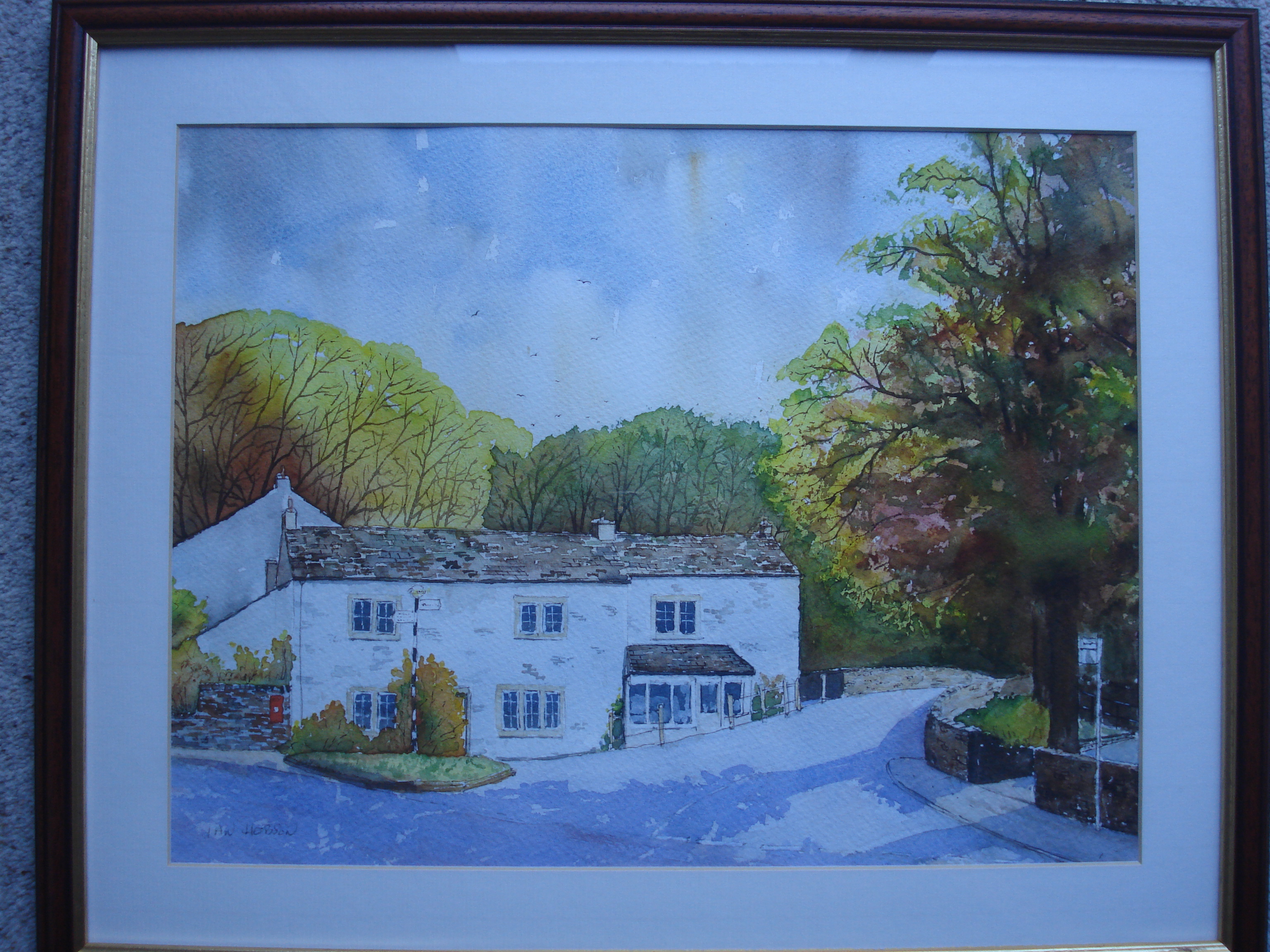
I started this blog/web-page in January 2008, in order to post images of my framed, original, watercolour paintings, which will be on show at local exhibitions (see latest blogs for venues) and also to publish some of my short stories and children's stories, which I hope you will read and enjoy.

Blog Archive

  • ▼ 2008 (12)
    • ▼ January (6)
      • The Footbridge, Linton, Wharfedale
      • Padstow pub
      • Denton in the Snow
      • Menston Footpath
      • Knaresborough Lido
      • Poppies
    • ► February (1)
      • Rocks and Water
    • ► March (1)
      • Footbridge near Timble
    • ► April (1)
      • Over the Stile
    • ► May (2)
      • Dob Park Packhorse Bridge
      • Abersoch west beach
    • ► July (1)
      • Over the Cattle Grid

Why Art + Stories?

Here's why:
Since October 2000, I’ve suffered from coccydynia, a painful medical condition aggravated by sitting. Needing something to do while standing, I took up watercolour painting. Meanwhile, as a contributor to a self-help e-group for coccyx pain sufferers, I was often told ‘you should be a writer,’ so I decided to give it a try – hence the stories, four of which have been published in the USA. *************** If you suffer from coccyx pain, I recommend that you visit www.coccyx.org ************************ If you liked, or disliked, any of the paintings or stories, and have any comments or questions, feel free to e-mail me - ianhobsonuk@yahoo.com
View my complete profile

Next Update

A new painting and story will be added before the first Sunday of every month.

Links - local, art & writing

  • http://wharfam.blogspot.com
  • http://www.redvenice.me.uk/deVotemagazine/devote
  • http://www.greatwriting.co.uk
  • http://www.abctales.com
  • http://www.nicestories.com
  • http://ilkley.org
  • http://www.guiseley.co.uk

Children's Stories

Story 1. THE BLACK POINTY HAT - A hat, a windy day and a scarecrow.

Story 3. ASPERULA'S RAINBOW - A sample story from Astrantian Tales.

Story 6. IMAGINATION - A young boy has a problem with his English homework.

Other Stories

Story 2. A SAXON'S TALE - A man and his son return from battle to find their village burned and their neighbours murdered.

Story 4. BRAKENTREE - A family rent a holiday home, not realising that it's already occupied.

Story 5. METAMORPHOSIS - Fantasy about an imprisoned cyclops.

Story 7. THE LOOKING-GLASS - Fantasy about a beautiful witch.

Over the Cattle Grid


0 comments

Abersoch west beach


0 comments

Dob Park Packhorse Bridge


0 comments

Over the Stile


0 comments

Footbridge near Timble


0 comments

Rocks and Water


0 comments

Poppies


0 comments

Knaresborough Lido


0 comments

Menston Footpath


1 comments

Denton in the Snow


0 comments

Padstow pub


0 comments

The Footbridge, Linton, Wharfedale

0 comments
Subscribe to: Posts (Atom)

Story 7

The Looking-Glass

©2004 Ian Hobson

The light was fading rapidly, as was the summer, but the evening was still warm. He took her hand in his and gave it a gentle squeeze, but then suddenly, he was gone, leaving Astana sitting alone beneath the willow tree. But Astana was used to Valdo’s sudden departures; his habit of melting away, or sometimes, when he was feeling theatrical, vanishing with a loud ‘pop’ or in a cloud of green or orange smoke.

She sat for a while and then, rising from the bench, she stepped lightly along the stone pathway and up the steps towards her cottage. There was a light breeze, and the full moon, now just visible as it almost crested the tops of nearby trees, conspired with them to cast dancing shadows across the garden. Astana stopped beside the small circular pond and, using a spell the old warlock had taught her, she raised and tilted its mirror-like surface, to look at her own reflection.

She was beautiful. Her features were fine, as though chiselled from granite, yet her skin was as smooth as porcelain. In the moonlight her long golden hair shone, her emerald-green eyes sparkled, and her full-length gown of ivory coloured silk seemed to flow over her feminine form like melt-water running over a frozen waterfall.

‘I have much to thank you for, Valdo.’ Astana’s voice was as soft as falling snow. She stood for a moment then, as she turned away towards the cottage, she let the pond fall gently back into place; causing circular ripples to run from its circumference to its centre, where they took the form of tiny fish, leaping above the surface and returning with a splash. From the shadows beneath a bush, a black kitten raced to the edge of the pond, stopping just in time to avoid falling headlong into the water.

‘There you are, Caldra.’ Astana had turned full circle and was looking down at the kitten, as it playfully reached with its right paw towards the centre of the pond. ‘You’re not still falling for that trick, are you? You should know better at your age.’ Caldra meowed as she looked up at her mistress, enquiringly.

‘Yes, Valdo has gone. Though I don’t know why you are so afraid of him.’ Astana reached down to stroke the kitten; and as she ran her long fingernails through the sleek black fur along her flank she purred loudly, arching her back and lifting her tail. ‘Look at all he has done for us. You had almost used up the last of your nine lives, but he’s given you nine more.’

Once more Astana turned and continued along the pathway towards the cottage, now with Caldra skipping along behind her. The scent from the last of the summer’s climbing roses filled the air as they passed through the pergola, and a fresh fall of petals carpeted their way. The cottage stood in darkness, but as Astana approached, welcoming lights appeared in the windows as candles were lit inside. This time the magic was Astana’s own, for though her craft could not quite match Valdo’s, she was more accomplished than most witches.

Before Astana reached the threshold, the timber and iron-studded door swung open, and as she stepped inside, it silently closed, almost trapping Caldra’s tail as she leaped through the narrowing gap. Astana laughed. The newly refurbished cottage had a mind of its own and seemed to enjoy a little childlike mischief now and again.

The dapper-looking grandfather clock in the hallway struck nine, and with a wink, lifted its top hat and bowed stiffly towards Astana, before resuming its regular pose and its steady tick… tock. Astana stroked its polished mahogany frame as she past, before entering the parlour, where the log fire beneath the Adam stile fireplace began to blaze and long velvet curtains drew themselves across the single leaded window.

She looked even more beautiful in the firelight as she crossed the room towards the alcove beyond the fireplace; yet the long shadow she cast seemed distorted. In the alcove was another velvet curtain, but not until Astana stood in front of it and held up her left hand, did the curtain glide silently open, revealing a full-length mirror.

This part of Valdo’s miraculous spell was less than a pleasure, but served as a reminder of the gift he had bestowed on Astana. His words of warning echoed in her mind. ‘Remember, for the spell to remain unbroken you must return to the looking glass, daily, at the appointed hour and gaze upon yourself as you really are.’

The hag who gazed back at her was old and wrinkled; her nose long and crooked; her hair, straggly and grey; her eyes dull and lifeless. And her tattered gown, stained with the grime of years, couldn’t hide the stooping and withered shape of her aged form.

‘You were almost late,’ the old witch admonished, in a hideous croaking voice. ‘One day you will be late, and then I will be freed from this accursed looking-glass…’

Astana sighed and raised her hand, closing the curtain before her other self could say any more. Then suddenly, the youthful and handsome love of her life was beside her again. And, as she turned towards him and returned his smile, Valdo took her hand and gave it a squeeze.

Story 6

Imagination

©2008 Ian G Hobson

It must be almost a year ago now: my mum and dad had gone out and my granddad had come round to babysit. Not that I was a baby; I was just a few weeks short on my fourteenth birthday then. But my little sister was only six, so we needed a babysitter, apparently. Anyway, my sister had gone to bed and I was sat at the kitchen table doing my homework. I'd finished the maths, that was pretty easy. I've even got to like maths since my granddad told me the secret of how to get good marks.

I remember my granddad saying, 'Your exercise book looks like someone's tipped a load of numbers onto the page and then given it a good shake. It's no wonder you get low marks; your teacher can't make head nor tail of it.' He was right: teachers like you to be very neat, you see. Like when you're doing equations – you have to keep all your equal signs in line down the page, then it's easy for the teacher to mark. And even if you get the wrong answer, they'll still give you higher marks 'cos they can see where you went wrong, and they like that lot better than if the page is a mess, even you've got the right answer at the bottom. 'Keep it neat - that's the secret,' my granddad had said.

I was thinking about that when my granddad came downstairs from reading my sister a bedtime story. My computer was on the blink, so my dad had lent me his laptop so I could do my English homework (we're allowed to use computers for that). The homework was to write an essay, or a story or whatever, on any subject we liked, – but I could never think of anything to write. And I said that to our English teacher, Mrs Dickinson. So she said, 'Write about something you know about.' Yeah, very helpful - I don't know why I bothered asking. I mean, what the heck did I know about, beyond the fact that my bike had a puncture, City had lost three-nil at the weekend, and I'd had a boiled egg for breakfast?

'Granddad?' I said, as he came and got himself a beer from the fridge. 'Is there a secret to writing essays ‘n stories ‘n stuff?' He frowned, so I said, 'Mrs Dickinson says we should write about something we know about.'

He laughed then. 'That's the sort of crap advice teachers always give you. No, forget that. That's far too limiting at your tender age. If there's a secret, I suppose it's imagination. That and punctuation, because if you muck that up, anyone reading what you've written will loose track of what you are trying to say.'

'I see,' I said, looking at the blank Word document on my dad's PC.

My granddad ruffled my hair. 'Don't look so glum, Adam. We've all got an imagination, and as for punctuation, well, that's just common sense, and if you're stuck, just look in any of your reading books to see how it's done... Your Harry Potter books will do. You like Harry Potter, don't you?' I nodded. 'Well that all came out of what's-her-name's imagination.'

'J K Rowling,' I said, feeling non the wiser.

'Aye, that's her, J K Rowling; and who's to say you can't be as successful as her one day. Just use your imagination; write a sentence and think of one to follow it, and then keep going... Well, there's a programme on the History Channel I want to watch, so I'll leave you to it.'

'Thanks, Granddad,' I said as he went through to the living room. Though I was wondering what I was thanking him for, as I still had no idea what to write. Imagination? Just make something up? I scratched my head and had a think, and then I remembered that my granddad had been in the merchant navy when he was a young man, and it gave me an idea.

***

Running Away by Adam Howarth

There was this kid called Dave, and he lived with his mum and dad. Except that his dad wasn't his real dad, because his real dad had been killed in a car accident. No, Bryan was his sort of step-dad, as he wasn't actually married to his mum, he'd just lived with her since Dave was about seven. Anyway, he was a right boozer, was Bryan, always down the pub, and he smoked so much he smelt like an ashtray. Dave hated Brian because he was always making him do things, like the washing up, or cleaning the car, or weeding the garden. So, one day, Dave decides he's had enough, he can't take any more of this beer-swilling, ashtray smelling, fake dad, and he decides to run away. He was almost twelve years old, so why shouldn't he?

So one Friday night he stuffs a few things – some Mini-Mars Bars and a bottle of Pepsi and socks and stuff – into the rucksack his uncle Fred bought him for Christmas, and then he sets the alarm in his mobile phone for five o'clock and goes to bed. It took him ages to get to sleep, and it seemed like he'd only been asleep for ten minutes when the alarm wakes him up. It was the middle of June, so it was light early, and he got dressed really quickly and then went for a piss, though he didn't flush the toilet because he didn't want to risk waking Bryan or his mum.

He felt a bit sad about leaving his mum, because she wasn't a bad mum really, she just happened to have lost her first husband and then ended up with a boyfriend that was a beer-swilling, ashtray-smelling, pig.

Dave went back to his room and had one last look round at all his toys, and the computer his Uncle Fred had bought him for his birthday, before picking up his bag and his mobile phone and sneaking downstairs. Bryan always left his bunch of keys on the coffee table in the living room, so it was easy for Dave to let himself out of the front door and then lock it again and stuff the keys through the letterbox.

'You're up early.'

Dave nearly jumped out of his skin. It was next-door's milkman looking at him over the hedge. Dave’s mum always bought milk from Tescos, but next-door must have theirs delivered; he hadn't realised that, but figured he wouldn't as he was usually still in bed at this time.

'I'm going camping with a mate from school.' Dave whispered the lie. 'His dad's picking me up in about ten minutes.'

'Oh, well have a nice trip then,' the milkman whispered back, and then off he went. He had one of those electric milk carts that didn't make any sound at all. Dave watched to see which way he went and then ran off as fast as he could in the opposite direction. Not that he didn't have a plan; he was going to go that way anyway, as he'd decided to head for the canal and set off along the towpath. He'd once walked about three miles down the towpath with his Uncle Fred, who had told him that it was possible to walk all the way to Liverpool, though Dave couldn't remember how far that was.

It was cold down by the canal, but Dave had put on two t-shirts and his blue Nike top with a hood, so he wasn't too cold - especially with the running, and then the walking along to towpath. But after about an hour, during which time he'd seen no one, he decided to stop and have a rest beside a dirt road and a funny-looking bridge thing that could be swung out of the way when canal boats wanted to pass through. There was a bench, so he sat on it and had a drink of Pepsi and one of his Mars Bars.

'Got any more of those?'

For the second time that morning Dave nearly jumped out of his skin, because right behind him in the bushes was a tramp, slowly getting to his feet. But there was something very odd about this tramp because, apart from the way he was dressed, he looked very familiar, as though Dave knew him from somewhere.

'I'll swap you a drink of milk for one,' said the tramp, as he took a pint bottle of milk from the pocket of the scruffy jacket he was wearing.

By then Dave was off the bench and standing clutching his rucksack to his chest and looking very suspiciously at the tramp. 'You're next-door's milkman,' he said. 'I saw you this morning.'

***

My granddad came back into the kitchen then. 'How are you doing, Adam?' he asked, looking over my shoulder and reading what I'd written. 'Mmm, I can see one or two spelling mistakes that the spellcheck-thingie's missed, and you need to add a comma or two.' He showed me where the spelling mistakes were, and where the commas were missing. 'Not bad though,’ he said. ‘Keep going, Adam.'

I was a bit pissed that he'd interrupted me, as I was dying to know what was coming next in this story that seemed to be writing itself. But I thanked him for his help, and he got himself another beer and went back to watch more television, while I read my last three paragraphs and then carried on writing.

***

'Ah, that will be my twin brother, Alfred,' the tramp replied. 'He always drops off a couple of pints for me... That was a Mars Bar you were eating, wasn't it? I could really fancy one, and I'll give you this full bottle of milk for one, if you've got any left.'

'I don't like milk,' said Dave, 'but you can have a Mars Bar if you want, they're only mini ones though.' Dave reached into his rucksack and handed a Mars Bar to the tramp, who thanked him and then sat down on the bench to eat it.
Dave pushed his hood back off his head and went and sat beside him, just as his mobile phone began to ring.

'Are you going to answerer that?' the tramp asked.

'Don't know.' Dave took the phone from his pocket to see who was calling him. It was his mum. Checking the time, he saw that it was just after half-past-seven, and he wondered how come his mum was up so early on a Saturday. He switched his phone off and stuffed it into the bottom of his rucksack. 'I'll have to be going now,' he said.

'Don't go just yet,' said the tramp. 'Stay and chat for a while. I don't meet many young people.'

'Just for five minutes, then,' Dave said, then looking at the tramp, he asked, 'Where do you live then?'

'Oh, here and there, but mostly by the canal. I like to sleep under the stars.' The tramp took the top off the milk bottle. 'Are you sure you won't have some?'

'No thanks,' Dave replied. 'But what about when it's cold, or if it rains?'

'Oh, I usually find somewhere. There's an old hut beside the cricket ground about a half-mile that way.' The tramp pointed along the towpath and then took a swig of his milk. 'So where are you going then?'

'Me?' said Dave. 'I'm off to Liverpool. I'm going to be a merchant seaman, like my Uncle Fred.'

'I see,' said the tramp. 'Bit young though, aren't you... for starting a job, I mean.'

Dave sat up straight on the bench, trying to make himself look taller. 'My Uncle Fred said that my great-uncle George started work when he was fourteen.'

'I see,' said the tramp again, looking Dave up and down. 'I didn't realise you were so old.' Dave said nothing, thinking it best to keep quiet about being only eleven and three-quarters. 'So I guess you don't like school much then?' the tramp said, before taking another swig of his milk.

'It's alright,' said Dave, 'but that's not why I've left home.'

'Family problems?'

'Yeah.'

The tramp drained the milk bottle and then wiped milk from his mouth with the back of his hand and set the empty bottle down on the ground. 'Want to talk about it?' he asked.

The sun was higher in the sky and Dave could feel its heat on the back of his head. 'There's not much to talk about,' he said. 'My dad died, you see… When I was three, so I can't really remember him.'

'And your mum married again, did she?'

'Yeah. Well sort of married... to Bryan.' Dave, still looking at the tramp, had noticed that despite him being quite scruffy, he seemed to be very clean and didn't smell at all.

'And you don't get on?' the tramp asked.

'No, not really.' Now Dave noticed something else about the tramp. Something that was very strange indeed; he was casting no shadow. Dave looked at his own shadow, and then at where the tramp's should be, but before he could say anything, there was a terrific screech of brakes, and as he turned and looked towards the little road that lead to the bridge, he saw his mum leap out of his uncle Fred's Volvo and come running towards him.

'David, whatever are you doing, sitting down here, all by yourself? If it wasn't for your uncle Fred, I wouldn't have known where to look for you.'

'I'm okay, Mum,' Dave said, getting to his feet, and looking first at his mum and then at his uncle, who had also jumped out of the car. 'And I'm not all by myself, I'm...' Dave had turned to look at the tramp but he'd vanished; there wasn't a sign of him anywhere. There was just the empty milk bottle on the ground beside the bench. Dave's mother wrapped her arms around him then, and began to cry.

'We've found him,' said Uncle Fred, ruffling Dave's hair. 'No harm done. Now how about a fry-up, back at my place?'

As Dave was driven to his uncle Fred's house, with his mum sitting with her arm around him in the back of the Volvo, he was thinking about the tramp and wondering where he had gone. Then he remembered the tramp's twin brother. 'Mum,' he said, 'do the Watsons, next door, have a milkman?'

As Dave's mum frowned and shook her head the car arrived at his uncle's house and Fred yanked on the handbrake and turned to look at Dave. 'What did you say?'

'I just said, “Does next door to us have a milkman?”'

Fred looked at his sister-in-law. 'I didn't tell you why I came round so early this morning, asking to see Dave, did I?'

'No, but I was wondering why, and how you knew where to look for him.'

'It was because I had a dream and it woke me up.' Fred looked at Dave. 'I dreamt that your dad was still alive and that he was a milkman. But in the dream he was crying because you had fallen into the canal by the old swing bridge and you were drowning, and he was pleading with me to come and save you, and when I woke up I could remember every detail and... Well, it all seemed so real, I thought I'd better go round to your house and see if you were okay.'

'Was there a tramp in your dream?' Dave asked.

'No,' Fred answered. 'Why do you ask?'

But before Dave could say any more, his mum burst into tears again. 'And what did Bryan do when you came round, and we found David missing?' she asked between sobs. 'Just went back to bed! Well, it's the last time he sleeps in my bed, or my house. When I get home, he can pack his bags and get out!'

Slowly, a smile spread over Dave's face. 'Can we have bacon, eggs and fried bread, Uncle Fred?' he asked.

***

My granddad came back into the kitchen then and sat and read the rest of my story. 'By heck,' he said. 'I think we've got a writer in the family.' And so I typed:

THE END

Story 5

Metamorphosis

© 2004 Ian Hobson

Given the amount of time Brantley had been down the hole, it was amazing his single, lid-less eye could still focus; yet he could make out the shape of one of his jailers above, silhouetted against the grey light of dawn.

Would today bring food or an upended bucket of icy water, or worse? After countless days of imprisonment, he knew to expect anything. As he heard the scrape of the wooden bucket, he pressed himself back against the side of his tomblike prison, relieved as he saw that it was being lowered, not tipped. He snatched at it and grabbed for its meagre contents before it was quickly hauled back up.

Bread and a half-rotten apple. He ate the food then knelt and lapped water from the tiny pool in the floor of the old well. The flow was, at times, not much more than a trickle, but it had never dried up completely. Brantley had considered blocking the outlet and allowing himself to be drowned, but his will to survive had proved stronger than his despair. Suddenly there were more sounds from above.

'Who wants him?' asked a gruff voice that Brantley knew well. It was Falmuth, the head jailer.

'Orders from the King,' came the reply. Brantley knew that voice also, but had not heard it for a long time. As he looked up, the end of a rope ladder fell towards him.

'Move yourself, prisoner,' ordered Falmuth. 'If I have to come down there, it will be the worse for you.'

Brantley grasped the ladder and climbed awkwardly towards the daylight, and as he neared the surface, Falmuth grabbed a handful of his hair and hauled him out. With his right hand, Brantley shaded his one eye against the brightness. The prison courtyard was circular, and he could see other prisoners staring open-mouthed at him through barred windows. Most had seen him before; but still, the sight of a childlike Cyclops - especially one so deformed and ugly - was something incredible.

'You don't get any prettier, do you, Cyclops?

'And you don't smell any sweeter, Foul-mouth,' croaked Brantley. This earned him a vicious stroke across the back with the short leather whip that Falmuth carried. It was painful, but Brantley did not cry out.

'Let him be!' This time Brantley could see who was giving the orders: Lord Chiron, the king's bodyguard.

'Chiron.' Brantley spoke his name, and for a moment Chiron looked questioningly into Brantley's one eye, before gesturing to the two guards that were with him and turning and striding away. The guards stepped forward and, taking the prisoner by the arms, they followed after Chiron. Brantley was barely half their size, but somehow he managed to keep pace with them.

The prison was at the lower end of the castle, so the winding alleyways that they passed through led gradually upward. Brantley inhaled the fresh air, ignoring the stares of passers-by. Ahead, Chiron stepped through a gateway where guards sprang to attention, and as he disappeared from view, Brantley's guards quickened their pace. When they caught up with Chiron outside the doors to the great hall, he ordered the guards to wait and entered alone, giving Brantley a much-needed respite. But soon more orders were given, and Brantley was pushed forward and allowed to enter unaided.

Inside, the hall was lined with courtiers: lords and ladies and their offspring; all dressed in fine costumes and gowns. Brantley knew them all, but as he ran the gauntlet of their stares, he kept his eye fixed on the figures ahead.

King Branghust sat on the largest and grandest throne and beside him sat Esmeltha his queen. Suddenly, aware more than ever of his grotesque looks and ragged clothing, Brantley stopped, fearful of what new humiliation might lay in store for him; until the king beckoned him, ordering him to come closer. As he drew nearer to the king and queen, he saw that Chiron stood close by, and that beside him stood another, much older, man; a man that he did not recognise.

'So this is the little Cyclops.' The man stepped forward and looked closely into Brantley's eye. 'I have heard of them, but never seen one… I am Durghal. Please tell me your name?'

'My name is Brantley, sir… Prince Brantley.'

At this there was a gasp of disbelief from the courtiers and Queen Esmeltha began to weep silently.

'But Prince Brantley was not an ugly one-eyed creature,' said Durghal. 'I am told he was a handsome boy, with two good eyes. Why do you claim to be him?'

'Because I am him… at least, I was him.'

'Murderer!' shouted one of the courtiers.

'You killed the prince!' shouted another.

'Silence!' King Branghust spoke for the first time, and then looked at Brantley. 'You were found wearing my son's clothes, and your hands were stained with blood.'

'I told you father; I was attacked by… this.' Brantley pointed at his own chest. 'And I stabbed the creature with the sword that you gave me. Then… I can't remember.'

'Where did you stab him?' asked Durghal.

'Through the heart.'

Durghal nodded. 'I believe him, your majesty. I believe this is your son.'

'But how can it be?' asked the queen.

'It is a curse, but one that can be broken. Just as Prince Brantley must have broken it for another.' replied Durghal. 'Many years ago the king saved my life. Now it is time to repay the debt.'

With surprising speed for an old man, Durghal produced a dagger and stabbed Brantley through the heart, and then with Brantley's blood still on his hands, he thrust the dagger into his own heart.

It was then that the impossible happened: As Durghal bled to death, he began to shrink and distort, and his two eyes merged and became one. But before he died he saw the reverse happen to Brantley, and heard the cries of joy that came from the king and queen.

Story 4


Brackentree

©2003 Ian Hobson

Overlooking Lock Trool in the heart of the Galloway hills, Brackentree House provides comfortable accommodation in a peaceful and beautiful setting. Five miles from the nearest town, Brackentree is entirely independent of the outside world and will appeal to those wishing to get away from it all. Brackentree has full central heating, a fully fitted kitchen, two bathrooms, and sleeps up to eight people. Well-behaved pets welcome.

***

Mack wandered into the master bedroom and looked out of the window in gloomy anticipation. He hated visitors, they upset his routine and disturbed the peace and quiet. At least for these past few months, and even during Christmas for once, he had had the place to himself. Apart from when the cleaner, Mrs. Donald, had come to disturb him, with her scrubbing and polishing and hoovering. Though he had to admit, she was good at her job; quick, but thorough. And because he liked the place to be clean and tidy, he always kept well out of her way; usually in the attic. She never came up there; even when she did the two-day spring clean, which she had just finished the day before. The gardener had been, as well. He was less thorough. Mack turned his head to watch as a small flock of sparrows alighted on the newly cut front lawn, pecking at it and playing aerial leapfrog with each other.

He turned his attention back to the driveway. Saturday afternoon. Now it would surely start. Visitors. Mack hated them. Especially the large family groups with children. Poking about in every nook and cranny. Hiding and then jumping out at each other, pretending to be ghosts. Mack had never believed in ghosts. Never understood why perfectly ordinary folk would start to ramble on about ghosts and hauntings, just because they happened to be staying in a beautiful old house. Mack had lived at Brackentree for more years than he could remember. Ever since his wife, Beatrice, had inherited it from her uncle, back in the fifties.

'Why ever did she leave me?' Mack asked himself, and not for the first time. 'She only had a bad cold. People shouldn't die of bad colds.'

'And why did she will Brackentree to Gerald?' might have been Mack's next question, but he had learned to stop asking himself that one. It upset him to think that his wife could have betrayed him so; leaving the house, lock, stock and barrel, to their money-grabbing son. But then, before she died, she had become very odd. Hardly ever talking to him and never listening properly to what he had to say.

It wouldn't have been so bad if Gerald had come back to live at Brackentree. But no, without even consulting his father he had turned the place over to letting agents; after first installing central heating, and new plumbing, and new kitchen cupboards, and all manner of shiny white machines that hummed, gurgled, whined and vibrated as though about to explode.

Just as Mack stepped back from the window, a vehicle pulled into the driveway. To Mack, it looked like a cross between a car and a minibus. He remembered that a family the previous year had had one just like it; a Renault-something-or-other. He couldn’t remember. The sound of rubber tyres on gravel startled the sparrows and they flew off into the trees. The vehicle ground to a halt in front of the house, but just far enough away from it for Mack to watch without stepping back over to the window. As the doors were flung open, a young couple climbed out, soon followed by three children; two girls and a boy. No dogs, Mack noticed. Good. Dogs were a bloody nuisance.

The man stretched and rubbed his back, looking the house over as though he was trying to estimate its value. The woman came and stood beside him. 'It's big, isn't it,' she said. Her accent was English. Northern, but well below the Borders, Mack decided.

'Well, it sleeps eight,' the man replied. Another northern English accent. 'Where did they say the key was?'

'Under a plant pot beside the door.'

'I'll find it, Mum!' said the boy. He was the youngest of the three children. He ran towards the front door and Mack heard a scraping sound as the boy tilted the large terracotta pot that stood beside it. 'I've got it!'

'Be careful with that pot, Edward,' warned the boy's mother. Mack heard the pot rock back into place.

The rest of the family disappeared from view as they too approached the house, and Mack heard the key in the lock and the sound of the front door opening. He left the bedroom and went to stand in the shadows near the top of the stairs, looking down on the family as they entered the house. There was a time when he would have gone down to welcome them. But he had soon learned that visitors had been instructed to ignore him. He could just imagine what had been said. 'Take no notice of the boring old fart that lives in the attic. He won't bother you, if you don't bother him.' People were so rude these days.
'What's that pong?' the eldest girl asked, as she followed the rest of her family inside.

'It's just a bit musty, that's all,' replied the woman, opening the nearest door and discovering the lounge, complete with colour television and video. 'We might be the first to stay here this year. It'll be alright when we've had the widows open a bit.'

'I bet it's haunted,' said the other girl. The man stepped behind her and grabbed her shoulders, mimicking deep rumbling ghostly laughter.

'Get off, Dad!' The girl shrugged her father's hands off her shoulders. 'It might be haunted, anyway.'

'Well, if it is, perhaps the ghosts would like to give me a hand with the suitcases.' The man turned and walked back outside.

'Where's the bathroom?' asked the older girl, moving towards the staircase. 'I need a pee.'

'So do I,' said the younger girl, following.

'I need one first,' said Edward, pushing past his sisters and racing up the stairs.

'No you don't!' they shouted, in unison, chasing after him.
'There’s supposed to be two bathrooms! But let Edward go first.' The woman turned and walked along the corridor, her sixth sense guiding her unerringly towards the kitchen.

As the children reached the landing, Mack backed into the doorway of what used to be his son's bedroom, lingering just long enough to stick out his foot and trip the boy. He didn't like boys. Edward went sprawling across the floor, and began to cry loudly but unconvincingly.

'Now what's the matter?' The man was at the foot of the stairs, a suitcase in each hand.

'Naomi tripped me!' the boy managed to say, between howls.

'I didn't!' exclaimed the oldest girl. 'Did I, Melanie?'

The boy got to his feet, momentarily unable to speak or cry, as his lungs were now empty. He gulped air and then began to howl again.

'Oh, shut up, you big baby,' said Naomi.

'He did seem to trip over something.' Melanie was examining the carpet. 'But I can't see anything.'

'Well, put a light on or something,' said the man, as he carried the suitcases up the stairs. 'It's dark up there. You'd think they'd have painted the walls a lighter colour.'

Naomi opened the nearest bedroom door, and the light from its window illuminated the landing. 'I want this room, Dad,' she said, as she looked inside.

The old wooden flooring creaked as her father came and stood behind her, looking over her shoulder. 'You and Melanie can share it. There are twin beds, look. Feels cold though. I think we better put the heating on for a bit.'

'I want to share a room!' exclaimed Edward. He had stopped crying. 'I don't want to sleep on my own if there's ghosts.'

'I'll share with you if you like,' said Melanie.

'There's no such thing as ghosts.' The man put the suitcases down and lifted his son. 'Are you alright now?'

'You should see the kitchen.' The woman was back at the bottom of the stairs. 'It's got a microwave and a tumble dryer and everything. And the view from the window is brilliant. You can see right down to the loch… Have you found the bathroom yet? I've found one next to the kitchen.'

The girls began to open more doors, soon finding the upstairs bathroom and disappearing inside. Edward wriggled out of his father's arms and ran down the stairs to his mother. 'I want to use the one downstairs.'

As the man picked up the larger of the two suitcases and carried it into the master bedroom, Mack came out of his son's old room and made his way silently along the landing towards the one remaining closed door. This was marked 'Private' and led to the attic stars; and as Mack climbed to his retreat he sighed to himself and wondered how he would get through another season. Bloody visitors!

***

Despite it being only mid April, the weather had turned very warm, and the visitors - the Bradshaws, Mack had soon learned - were making the most of it. There was just the one tiny window in the attic, but from there Mack could see the two adults and the eldest girl sunning themselves in the back garden. The younger children had discovered the orchard and were playing their own version of hide and seek, which for some reason unknown to Mack, included a lot of screaming. Worse than that, only two days into their holiday, Mrs. Bradshaw had started to use that unspeakably noisy contraption in the kitchen.

Suddenly the high-pitched whining of the automatic washing machine stopped and all was quiet. Mack, realising that at least for the moment, the house was his, made his way down to the kitchen. There were plastic bags full of groceries lying on the table; the proceeds of an early morning foray into town. And the little oven thing, with the glass door, was humming gently, with a chicken on a glass plate rotating inside it.

Mack thought about helping himself to something from the fridge. He opened the door. The shelves were piled with all manner of things, mostly in colourful plastic tubs and wrappers. 'What on earth is Muller Light?' Mack wondered. There was nothing there to tempt him; not even the cans of Foster's lager. His appetite these days was not what it was. A symptom of old age he thought. And he had never liked lager. Whiskey was a man's drink.

Hearing footsteps approaching from outside, Mack quickly retreated to the corridor. Mr. Bradshaw entered the kitchen and stopped as he saw that the fridge door was wide open. 'Edward!' he shouted, sticking his head back through the door. 'How many times do I have to tell you to stop leaving the fridge door open!' He stepped back to let Naomi in through the doorway.

'He can't hear you. He's right down at the bottom of the garden. Mum was in here last, anyway… What's for lunch?'

'You better ask your mum.' Mr Bradshaw walked over to the fridge and reached inside. 'I'm just after a beer. Do you want a Coke or anything?'

'I'll have a lager.' Mrs. Bradshaw padded barefoot into the kitchen. 'I can't believe how warm it is. And that view. I think I could sit and look at it for the rest of my… Oh, now what?' Outside Edward had begun to scream and clearly this was not part of the game he had been playing with his sister.

Naomi looked through the window. Melanie was racing up the garden path towards the house. She burst in through the door. 'Edward's been stung by a bee!' Naomi rolled her eyes and shook her head as Melanie and her parents rushed back outside.

'Serves him right,' said Mack, as he reached the bottom of the stairs and began to climb them.

Naomi turned towards the corridor. 'Creepy old house,' she said, before taking a bottle of diet coke from the fridge and closing the door.

***

Edward's bee sting had done him no permanent damage and by the evening the swelling had gone down. After a chicken dinner, the family gravitated to the lounge, where Mack heard them arguing over what to watch on television. Eventually they agreed to watch a video: Nightmare on Elm Street. Mack had seen this one before and thought it thoroughly ridiculous. He recalled the time another family had watched it and the subsequent screams in the early hours of the morning when he had inadvertently wandered into an occupied bedroom and sat on the bed. He stood outside the lounge door, chuckling to himself at the memory.

'Who's there?' Melanie was coming along the landing towards the top of the stairs, carrying a teddy bear. Mack hadn't realised that she was up there. As she reached for the light switch, Mack shrank back into the shadowy corridor.

'Dad, if it's you, you're not frightening me,' said Melanie, as the hall light came on and she walked resolutely down the stairs. Just then the lounge door opened, so Mack slipped into the dinning room.

'Come on, Melanie. You're going to miss the film.' It was Naomi. 'We're not waiting any longer.'

'I thought I heard a funny noise,' said Melanie.

'It'll just be the wind or this creaky old house,' replied Naomi. 'I heard a funny noise before.' But at that moment there was a crash as something in the dinning room hit the hardwood floor and shattered. The two girls stood and looked at each other. The rest of the family immediately joined Naomi, who was still standing in the lounge doorway.

'Now what have you broken?' asked Mr. Bradshaw.

'I think there's someone in the dinning room,' said Melanie. 'I think it's the ghost.'

'There's no such thing as ghosts.' Mr. Bradshaw headed towards the dining room, immediately followed by his wife and the three children. He switched on the light and looked inside. There was no one there and the door to the kitchen was closed. One of Edward's toys was on the floor at his feet, and close to it lay a shattered vase. 'It's just that vase that was on the little table beside the door. It must have fallen off.'

'Things don't just fall over by themselves, Dad,' said an obviously worried Naomi. 'I think you should search the house.'

'It's kind of you to volunteer my services.' Mr. Bradshaw suddenly seemed a little less confident.

'I'm not staying here while you search,' said Melanie.

'An I'm not!' Edward's eyes were beginning to fill with tears and he tugged at his mother's sleeve until she lifted him onto her hip.

'Shall we search together?' she suggested. 'All of us?' Though she didn't lead the way. She left that to her husband.

Meanwhile Mack was in the kitchen. He had trodden on Edward's toy and then knocked the vase off the table. Now he felt like a sneak thief in his own… well, his son's own house. And as he heard the family hesitantly approaching the connecting door he slipped out and walked stealthily along the corridor and back into the hall.

He had meant to go back upstairs but, without knowing why, he opened the front door and looked out into the semidarkness of the moonlit evening. He hadn't been outside for a long time. He knew that there was a reason for this but it had slipped his mind. Another consequence of old age, he reminded himself; memory lapses. He stepped over the threshold and quietly closed the door, but then it came back to him. There was something wrong with outside; something frightening. It began immediately the door was closed. It was like being in a violent storm. Wind tugged at his clothing. Leaves fell from the sky and swirled about him. Yet there was no sound and the moon or some other light source had become so bright that he could hardly see.

He turned to go back inside but a female voice called his name. He remembered hearing her call before, but fear had always driven him back inside; back into the safety of the house. As she called again he steeled himself and turned towards the sound. The shadowy figure of a woman was walking along the drive towards him. And she walked straight through the Bradshaw's motor vehicle as though it wasn't there.

'Don't go back inside, Mack,' said Beatrice. Her voice was clearer now and her Scottish lilt sounded so sweet to him. She took hold of his hand and together they walked away, and Brackentree was haunted no more.

Story 3

Asperula's Rainbow

© 2006 Ian G. Hobson

It was a typical Astrantian afternoon, with warm sunshine and not a cloud in the sky; and Asperula was sitting in her garden reading. As you may recall from earlier stories, Asperula was a witch, and what she was reading was an old book of magic spells that she'd forgotten about and then rediscovered when if fell from a shelf as she dusted it.

The spell book had proved very useful. Asperula had deciphered some of the ancient writings and discovered spells to cure everything from toothaches to in-growing toenails, and from hiccups to spotty faces. She had found spells to mend leaky roofs and straighten crooked chimneys, and to chop fallen trees into firewood, and even to turn weeds into flowers. So her cottage was looking much smarter than it ever had before, and her garden was the best in the whole village.

'Rap, Rap, Rap! Visitor!' announced the shiny doorknocker on her front door. The doorknocker was, of course, a magic one, and it had become very good at predicting exactly when someone would arrive, even before it could see them coming. And sure enough, as Asperula looked up from her book, Thymus the cat sprang up onto the garden gate and then dropped down onto the garden path. He was on his way home after visiting his friend Luzula in the village, and having heard about Asperula's beautiful new garden, he'd come to take a look.

'Shoo!' exclaimed Asperula, as Thymus approached. 'I don't have black cats in my garden; they're bad luck. Now shoo, before I turn you into a goat!'

Thymus stopped and sat down to lick at each of his hind legs in turn. He wasn't the least bit afraid of Asperula. He lived in the old tower, across the river, with Holcus the warlock and knew almost as much about magic as Asperula did.

'If you turn me into a goat, I'll charge at you,' he said, interrupting his grooming and looking around. 'And I'll eat your flowers.' Then he noticed the book that Asperula held in her hand. There was a face on the front cover; an unsmiling but familiar looking face. 'Doesn't that book belong to Holcus?' he asked. 'It looks like one of his.'

Asperula thought for a moment; she had completely forgotten that the book had once belonged to Holcus. Then she remembered that Holcus had thrown the book at her after they had argued over something; they were not exactly the best of friends. 'It might do,' she replied, 'but that's none of your business. Now shoo!'

'Very well,' said Thymus, turning back towards the gate. 'I know when I'm not welcome.'

Asperula returned to reading her spell book, but just as Thymus leaped back onto the gate, she looked up and said 'Wait… Does Holcus ever travel by rainbow?'

Balancing easily on the top of the gate, Thymus turned back to face Asperula. 'Travel by rainbow?' he repeated, looking puzzled. But then he remembered hearing something about witches riding rainbows as an alternative to broomsticks. 'No, I don't think so, but he never goes anywhere these days anyway. Why do you ask?'

'Never mind,' replied Asperula, returning to her book.

'Ah, I see,' said Thymus. 'You've found something in the spell book about rainbow-riding. Well, you'd have to find a rainbow first. I can't remember the last time I saw one… Perhaps you should start by making it rain.' And with that, he turned and dropped down the outside of the gate and was gone.

'Making it rain,' said Asperula. 'What nonsense.' But then she looked up from her book with the beginnings of a smile on her face. Since finding the rainbow-riding spell she had felt a surprising urge to try it out, perhaps because she remembered stories of her great-grandmother travelling that way. But rainbows needed summer rain-showers; a rarity in Astrantia. So there was little chance of her doing so, unless: if she could find a spell to make it rain enough for a rainbow, then maybe she could give it a try. Perhaps a black cat in the garden was not such bad luck after all.

For the rest of the afternoon, Asperula studied the spell book, struggling with some of the ancient writings, until finally, on the very last page, she discovered what she was looking for: spells for making rain. One was for storms, with thunder and lightening, and one was for night-time rain, for people who wanted their gardens watering but didn't want to get wet.
Then she found just the one she wanted: a magic spell to make long summer showers, complete with rainbows. And she began preparations for trying it out on the very next day. She stoked the fire under her cauldron and danced around it, throwing wild flowers and herbs into the boiling liquid, and chanting:

First Hog Weed and Borage
Go into the pot
(I must get some more
Because I use them a lot)

Then Hawk Weed, for Orange
And Curds Dart for Blue
And King Cup for yellow
What a colourful brew

Now, Hair Grass for indigo
Hart's-tongue for green
And a sprig of fresh nettle
To keep the pot clean

That leaves Columbine for Violet
And Poppy for red
Give a really good stir, and
Then straight off to bed

And so off to bed she went, leaving the window open so that the steam from the simmering cauldron could make its way out into the night air where it could do its magic. And sure enough, when Asperula awoke in the morning, there were clouds gathering in the sky. So she dressed and put on her best apron and best black cloak, and carrying the old spell book, she set off towards the river where most of the clouds had assembled.

***

Thymus slipped in through the cat-flap in the back door of the old tower. The tower was more like a house really, as over the years, a roof and a chimney, and doors and windows, had been added. He padded across the stone floor of the kitchen towards the staircase. The kitchen was circular in shape, as was the tower itself, and the staircase ran around the wall in a spiral and led to the circular living room above and then on to the circular bedrooms above that. There was even a circular dungeon below, as the tower had once been part of a castle, most of which had crumbled and fallen.

'Hello,' said Holcus, sleepily, when Thymus appeared at the top step of the first floor and padded across the room towards him. 'Been out all night?' The warlock, wearing an old grey dressing gown, was sitting in semi-darkness in his favourite chair beside a huge fireplace. The sunlight that filtered through a large curtained window showed that he was old and thin in the face, and his hair was grey and straggly, but there was a proud, intelligent look in his eyes. He reached down and stroked Thymus who lifted his tail and arched his back and purred.

'No, I've not been out all night,' Thymus replied. 'But I woke early, so I thought I'd go out and see what the weather was doing.'

Holcus laughed at this. 'I could have told you that without going outside,' he said. 'The sun is shining and the weather's set fair, as always.' He reached for the crook that was leaning against his chair, and gave one sharp tap on the floor with it, and the curtains opened to reveal a lovely view of the fields and river but with rain clouds not far away.

'Not quite, you see,' said Thymus. 'The sun is shining, but there are some thick black clouds out there and it looks likely to rain.' He had an idea he knew why, but decided to say nothing to Holcus. He took his usual place on the rug in front of the fireplace. The fire was not lit, as it was the middle of summer, but at other times of the year, in front of the roaring log fire was one of Thymus's favourite places to be.

***

With the sun behind her and feeling very pleased with herself, Asperula made her way across the fields towards the gathering clouds. Hanging from a gold chain around her neck was her talisman, a jet-black stone from the middle of a shooting star. The talisman was relatively new and it had taken time for Asperula to get used to it, but gradually it began to yield its magic and slowly it had enhanced Asperula's powers and increased her understanding of spells like the one she was planning to use to ride a rainbow.

Rainbow-riding, as practised by witches since the beginning of time, is a novel way of getting from one place to another. It's especially useful for getting over obstacles like fast flowing rivers or for simply getting from one side of a valley to the other. Though many witches think it a ridiculous way to travel because, firstly you have to find a rainbow, and secondly you have to get to it - which isn't as easy as it sounds because rainbows do have this habit of moving away as you approach them - and thirdly, the other end of the rainbow has to be in the place you want to get to. So mostly it's just done for enjoyment – a joyride, in fact – or sometimes just to show off.

Asperula hurried along, with a spring in her step that she hadn't had for many a year. She even giggled at the thought of riding a rainbow. And suddenly ahead, as the clouds began to shed their rain, there it was: a beautiful rainbow, with all the usual colours – red, orange, yellow, green, blue, indigo and violet – arcing across the sky and reaching over the fields and across the river.

Asperula opened her spell book at the right page and referred to the text. She knew that the first step was to make the rainbow keep still while she made her way to it. As she walked on, she read aloud the magic words, but the clouds and the rainbow seemed to drift away as though pulled by the river as it meandered downstream. Asperula clutched her talisman and repeated the words, over and over, and at last found that she was getting closer and closer to the rainbow. But she was also beginning to get quite wet so, as she walked on, she tore a bright green bracken stem from the ground and uttered more words of magic and immediately the bracken stem turned into an umbrella which she held aloft to keep from getting wetter.

Once more she referred to the book of spells before dropping it into her apron pocket, and with talisman in one hand and umbrella in the other, she reached the rainbow and stepped into its brilliance, reciting the rainbow-riding spell. For a moment nothing happened, then with an exhilarating whoosh, she was carried away, spiralling head first and with her black cloak flapping behind her, up into the rainbow's colourful core - but a little faster than she had expected for, almost immediately, the umbrella closed about her head and she couldn't see a thing.

'Get off me!' she cried, as he fought with the umbrella, finally flinging it aside and letting it fall. Now she could see, and what an amazing site it was too: she was surrounded by colour and yet, through it, she could see the greenery of the surrounding countryside and the sparkling blue river below and the charcoal-grey rain-cloud above. And then she crested the top of the rainbow and began to descend, shrieking with laughter, and still spiralling headfirst, and having the ride of her life.

Anyone watching would have been quite amazed, for this was most unlike Asperula. But this was where things began to go wrong. The rainbow had obligingly kept still at one end while Asperula stepped inside it, but all the while the other end had continued to drift, swinging ever nearer to the old tower across the river. And as Asperula neared the end of her ride she saw with horror that she was not going to have the soft grassy landing that she had expected.

***

Both Thymus and Holcus had fallen asleep beside the fireplace as they quite often did, regardless of the time of day. But when a tremendous crashing noise came echoing down the chimney, they both awoke with a start. In fact Thymus, who was closest to the fireplace, was so startled that he shot up into the air and across the room as though someone had just stamped on his tail. And lucky he did because a great fall of soot came tumbling down and landed in the fireplace, before issuing a sooty black cloud into the room.

'Lightening!' exclaimed Holcus, as coughing, and choking, and blinking the soot from his eyes, he got to his feet. 'We've been struck by lightening!' But just then there was another crashing sound and more soot came down the chimney followed by a huge bat-like creature that Holcus thought must be some kind of demon. It was as black as night and as it landed headfirst, in the fireplace, it wailed like a banshee and clawed at the hearth with its scrawny talons, and its two pale eyes flashed with a terrible malevolence.

'Be gone, you evil spirit, you incubus, you demon of the night!' cried Holcus, as he peered at the creature through the soot-filled air. 'How dare you come down my chimney, unannounced? Be gone!'

Covered in soot and looking quite demon-like himself, Holcus reached for his magic crook and pointed it at the terrible intruder. In his younger days he would have instantly remembered the correct magic spells to ward off such an evil creature and send it on its way, but his memory was not what it used to be. But as he tried to remember the words, the creature got to its feet and, trailing its great black wings and more clouds of soot, it fled across the room and sped down the staircase and left the house by the kitchen door.

Thymus jumped up onto the windowsill and peered out. The garden and the adjacent fields were in shade, as a large black cloud hung overhead, and the ground was wet from recent rain. But almost immediately, as Asperula, with sooty hair and a torn black cloak, hurried away from the tower, the clouds vanished and the sun shone once more.

'Bless me,' exclaimed Holcus, as he reached into the fireplace and lifted something from the soot-filled hearth. 'How ever did you get up the chimney?' He blew the soot from the old spell book, and watched as the face on the front cover began to smile at him. The spell book was glad to be back with its master.

>>><<<

Asperula's Rainbow is one of fifteen stories set in the enchanted land of Astrantia. To read more Astrantian Tales visit: http://www.abctales.com/story/ian-hobson/astrantian-tales

Story 2

A Saxon's Tale

©2007 Ian Hobson

10th Century AD

After another night in the open and a morning's weary travel, we bid farewell to the others from our group and left them to take the western track towards the main settlement. We headed north and followed a steady uphill path, taking a short-cut over the hilltop. Edglaf walked ahead of me carrying my axe and a sheathed sword he had taken from a dead Dane. I carried my grandfather's sword and the water; we had no food left. The wound in my side still felt very sore, but it was healing.

The battle had not gone well. We had outnumbered the enemy by almost three to one, but they were mostly seasoned warriors, not woodsmen and farm workers like us. My son, Edglaf was barely fifteen years old but, like me, he worked Lord Athelred’s land, and Lord Athelred was sworn to Lord Byrhtnoth, so we had no choice but to go and fight as ordered. Besides, the Danes were here to steal the land, our livelihoods, and our women too.

Before the battle I’d sharpened the sword; it was old and heavy but well crafted, and the only weapon we owned. It was a big sword, made for a big man: my grandfather. I gave it to Edglaf, telling him to stay at the rear. I was in the middle behind Lord Athelred’s men at arms, but in front of other men less able, or less willing, to fight. I carried my axe: I was a woodsman and better at wielding an axe than a sword.

Edglaf stopped just short of the crest of the hill we were climbing and waited for me to catch up. During the battle I’d taken a spear thrust below my left armpit; a glancing blow that had cut through my leather jerkin and grazed my ribs. I’d swung my axe at the spearman, splintering his wooden shield and breaking his arm, but still he made ready to thrust again. That was when, to my surprise, I found Edglaf at my side, swinging my grandfather’s sword like he was born to it and killing my attacker with a thrust to the throat.

As a young man I had fought beside my own father, but never with such ferocity. It was Edglaf’s first battle and his first kill, and I was proud of my son, but also a little worried: he killed another Dane that day - before the battle was won and the Danes defeated – but with just a little too much eagerness, I thought, though I had also killed another. I prayed to God that he would stay with the land and not become a warrior like my mother's father.

As Edglaf stood and watched me climb he looked so like his mother. It was more than sixty days since Eadwynne had wept as we left, begging us not to go. But as I kissed her, and our daughter, Leofwynne, I promised her we would return. I made the same promise to my mother, but there were tears in her eyes too.

‘Wound still hurting?’ Edglaf asked.

‘A little.’ I rested for a moment, taking in lungfuls of fresh clean air, and pondering on what I would say to the widows of the two men who had not returned with us. Then we walked the last few paces to the top of the hill together; and there below us was our valley. It was a relatively new settlement, a half-day's march from the main one. I looked first for the tall trees just beyond the foot of the northern slope, and then for the clearing just below. It seemed that a mist shrouded our small dwelling, and I couldn’t make out its shape or see the yellow of the thatch. Then dread filled my heart as I realised that what I had thought was mist was smoke; and, my wound and tiredness forgotten, I began to run down the wooded slopes with Edglaf following.

***

We passed other dwellings as we crossed the valley floor; all of them smouldering ruins. Then we came across the first body: old Wiglam, I'd known him since I was a boy. His throat had been cut and his clothing ripped open. He was a poor man; I doubt that his attackers had found anything on him of value. His dog lay nearby, its head almost completely severed from its body. There were more mutilated and half naked bodies beside the bridge that I had built over the stream; we knew each of them well, especially the midwife, Silfled, and her second husband, Alfere, my cousin. He had lost an arm fighting the Danes five years before, yet by the look of his wounds and the bloody ground, he had put up a good fight. Downstream I could see the remains of a butchered cow and two sheep; all three had had hind or fore quarters hacked off and carried away. A smell of wood-smoke and death hung in the air.

I slipped my grandfather's sword into my belt and took the axe back from Edglaf, and then we hurried on. We had no time for the dead; we thought only of those we hoped would still be alive. Our dwelling was on slightly higher ground and we were both panting like dogs as we reached it. At one end the thatch was still burning, as was the oak beam above the entrance.

Ignoring the smoke and the heat, I staggered inside but immediately turned back. Just a few blackened timbers remained standing, the rest had fallen in and still smouldered and glowed with each breath of wind. No one could have survived such an inferno.

'Father!' Edglaf was running towards the tall trees, his sheathed sword flapping against his leg as he ran. I stood for a moment and then, as I saw what he had seen, I raced after him.

It was my mother, Elgiue. She lay beside the nearest tree with her head in a pool of blood. Edglaf had stopped a few paces short of her but I dropped my axe and ran past him. 'Mother!'
I knelt and cradled her head in my lap. There was so much blood, she was surly dead, yet her eyes flickered and then opened. 'Godwin?' As she whispered my name, blood trickled from the corner of her mouth.

'Mother,' I gasped, 'where are Eadwynne and Leofwynne?'

She looked up into my eyes and said just one word, ‘Danes,' and then the life went out of her, and she was gone.

'Mother!' In my grief I began to rock back and forth, still cradling her head. Edglaf knelt beside us with tears in his eyes.

'Men come.'

At the sound of another voice, Edglaf was on his feet and drawing his sword, but he slipped it back into its sheath as he recognised Maccus, the halfwit. I was a tall man, as was my son, but Maccus was at least a head taller than us and broad in the shoulder too. He had lived with Silfled, the midwife, for all of his nineteen years and called her Mother, though he was not truly her son. She had taken him in when his real mother had died giving birth to him and his father had rejected him because of his disfigured face.

'Wait!' At the sight of Edglaf's sword Maccus had started to back away. I laid my mother's head gently back down on the bloodstained earth and then stepped in front of Edglaf, showing Maccus my empty hands. 'We are your friends, Maccus. You have nothing to fear.'

'Men come.' Maccus repeated what he had said before.

'How many?' I asked. 'How many men?'

Maccus looked uncertain and I thought perhaps the question was too difficult for him, but then he held up both of his hands, spreading the fingers of his left hand and studying those on his right until he settled on just three.

'Eight?' I said.

Maccus grinned and repeated the word, 'Eight, eight men come. I climb tree and watch. Then come down.' His face changed, showing grief, as he looked towards my dead mother. 'All dead.'

'What about my sister, Leofwynne?' my son asked patiently. 'And my mother, Eadwynne?' In the past Edglaf had spent time with Maccus, playing games, fishing in the stream and helping with the harvest, so he knew better than I how to speak to him. 'Are they hiding, Maccus?'

'I hide when men come,' Maccus replied, pointing towards the eastern woods. 'Mother always say hide in woods if bad men come.' He looked uncertain again but answered Edglaf's question. 'Not all dead. Some go with men: Eadwynne and Leofwynne... and Alfere and Wiglem.'

I breathed a sigh of relief; my wife and five-year-old daughter were still alive. The other two, Alfere and Wiglem, were both young boys, sons of Beornwynne, one of the women who lay dead beside the stream. Her husband, Offa, had been fatally wounded towards the end of the battle with the Danes.

Edglaf continued to question Maccus until it was clear that the eight raiders had arrived at dusk the day before, just as Maccus was returning home with some firewood. He was uncertain about what had happened during the hours of darkness, but he had heard screams and said that the men had left at first light with their captives, after torching the thatch of every dwelling.

'Which way did they go?' Edglaf asked.

Without hesitation Maccus pointed towards the tall trees and then raised his hand indicating that the men and their captives must have climbed the hill to the north. Edglaf and I exchanged troubled looks. We knew that three or four day’s journey to the north there was a tidal river, and had heard that Danish ships had been seen there in the past. It was said that some came to trade, but others, often called Vikings, came to steal and to burn, and worse.

I prayed to God that my family had been taken to sell as slaves, and that we could somehow reach them in time. We had some silver that we had taken from the three Danes that we had killed, though it was probably not enough to buy more that one person's freedom. I considered sending Edglaf to the main settlement to fetch help, but decided we could not afford the delay. God forgive me, but I was angry, so very angry, and I wanted to hunt down every last Dane and kill them all.

***

I also wanted to bury my mother, but there was no time. We replenished our water from the stream and cut strips of meat from the butchered cow and looked quickly about for more food. It seemed there was none until Maccus emerged from one of the burned out buildings with some bread that had somehow escaped the flames. He also found a sack to put the food in and then insisted on coming with us. He was a child in a man's body but I was glad to have him along; with his height and disfigured face, he looked fierce enough, especially after I gave him my grandfather's sword.

Edglaf led the way, his keen young eyes picking out signs of those we followed, but the sun had begun to set by the time we neared the top of the northern hill. There was little cover here so we crawled on our bellies until we could see down into the next valley. It was heavily wooded and if there was anyone down there, we could not see them. We hurried on, unsure if we were taking the right path until, in a wide clearing, we found some well-trampled grass where the raiders must have stopped to rest or eat. I estimated that we were only a half-day behind them.

Maccus asked if he should collect firewood and light a fire. I wanted to continue on, but in the growing darkness we could easily have lost our way, so I agreed to the lighting of a small fire close to the base of a fallen tree where it would be screened by its trunk and circular mass of roots. Maccus was proving to be quite resourceful; using a flint he carried, he had a fire lit in no time and rigged a spit on which to cook some of the strips of meat we had brought with us. We ate, and drank a little of the water, and soon fell into an exhausted sleep.

When dreams of my mother rising from a lake of blood woke me it was no longer dark, and I thought that it was dawn and that too much time had been lost. But then I saw that an almost full moon had risen into a clear sky, and so I woke Edglaf and Maccus and we continued on, as best we could, through the shadowy forest.

***

When dawn came, the signs were much clearer and before midday we came to a deserted and ruined settlement where clearly the raiders had spent the night. I had walked this far once before and at the time wondered who had lived there and why they had left. Perhaps they too had been slaughtered by marauding Danes.

It was here that we found the body of a Saxon man. His throat had been cut and his clothes ripped open as his assailants relived him of anything of value. I recognised him as Sibirht, a man I had never liked or trusted. He was from the north-east and had lived in our community for a time, until he was expelled for stealing. We should have killed him, for now it was clear how the raiders had found their way to our small community; they had been led there. At least Sibirht had got his just deserts from the Danes who must have decided that they had no further use of his services.

We kept going. There was another hill to climb, but that would help us to gain time I thought, as a party that included a woman and three children would not travel as quickly. I was right: for late in the afternoon, as we crested another low hill, we at last caught site of those we followed. I could not distinguish which of them was Eadwynne, but there were at least two small children amongst them.

'Men,' said Maccus. 'Bad men.'

I exchanged a worried glance with Edglaf; we were both thinking the same thing: we could easily catch up with them now but what then? We were three against seven.

On the hillside we would have been at risk of being seen, so we backtracked a little and made our way down a shallow ravine until we were able to rejoin the route the raiders had taken. The trees here stood tall and close together, but there was a definite track and, where the ground was soft, we could easily make out footprints, including those of children. We moved quickly, making best use of the last rays of sunlight that penetrated the canopy. I let Maccus take the lead while I, having abandoned the idea of buying back the captives, walked beside Edglaf and discussed tactics. We knew that the Danes would probably stop as soon as darkness fell, and bed down for the night, and that that would be our best chance of surprising them. The birdsong was loud in this stretch of woodland, and a magpie chattered a warning that perhaps we should have heeded because, to our dismay, we had walked straight into a trap.

Six men had stepped out from behind the trees and surrounded us, each holding a drawn sword or a war axe, and I could tell by their clothing, that they were Danes.

‘Saxon, why do you follow us?’ one of them asked as he came closer. He was a big man, with a strong Danish accent, but he spoke our language well. He and two others blocked the pathway ahead while the other three crowded behind us, blocking our retreat.

‘What is your name?’ I asked him, trying not to show the fear that I felt, and desperately trying to think of a way out.

‘What is yours?’ The Dane seemed a little confused. He had addressed his first question to Maccus, mistaking him for our leader, and he had to peer around him to see my face.

But taking his eyes off Maccus was the last mistake he ever made on this earth, because it was then that Maccus drew my grandfather's sword from his belt and, shouting his mother's name, he swung it from left to right with such force that it scythed into the Danes neck, taking his head off in a shower of bright red blood; and as a war axe slipped from his right hand, the Dane's headless body crumpled and fell.

To our credit, and perhaps as a result of our recent experiences in battle, both Edglaf and I reacted instantly. I turned and, striding closer to the nearest Dane, I smashed the handle of my axe into his face and then dropped it onto his sword arm, while Edglaf drew his Danish sword and ran at the two men behind him. Clearly they were more accustomed to taking the lives of women and old men because the youngest turned and ran while the other was too slow in parrying Edglaf's sword as it slashed into his face.

I knocked my Dane senseless with another blow to his jaw and then turned to help Maccus who was trying to keep the remaining two Danes at bay with huge swings of my grandfather's sword, all the time shouting his mother's name as though it was a war cry.

But one of the Danes was an accomplished swordsman and was thrusting at Maccus, drawing blood, and forcing him backwards until he fell over the body of his headless victim. In a rage, I swung my axe at the swordsman, deliberately letting it slip through my fingers; which was something he hadn't expected because the head of the axe hit him hard in the face, and in the time it had taken him to recover I had snatched up the dropped war axe and swung it at his raised sword arm, cutting off his hand and leaving him screaming as I moved past him to take on the last of them.

It was now war axe against war axe, and as our blades clashed together I saw that my adversary had only one eye. He fought well, and might have beaten me, but I was so enraged that I seemed to have the strength of two men and needed no help from Edglaf or Maccus as I hacked the man to pieces.

'We have to go!' Edglaf said. 'There's at least one more ahead.' Not wanting to be outdone by Maccus, he had finished off the other three Danes by hacking off their heads with his sword, and he was covered in their blood.

But he was right; there was no more time to loose. I stopped my butcher's work and, weapons in hand, we hurried on in the growing darkness. We wanted to call out the names of our loved ones but thought it better to remain silent, rather than give a warning to whoever was guarding them. It was the right decision because, in the darkness, the one remaining Dane mistook us for his shipmates and by the time he had realised his mistake, Edglaf and Maccus were chasing after him, and his dying screams echoed through the forest as I found Eadwynne and the three children safe and relatively unscathed.

***

It took us almost three days to return to our valley and the gruesome task of burying the dead. We carried home the few goods of value stolen from our small community as well as most of the Danish weapons. We never found the young Dane that had run away from us, and don't know if he made his way back to his ship or not. Eadwynne and I exchanged stories and she wept as she told of the slaughter of our friends and neighbours, but if she was raped by the Danes, she chose not to speak of it, and I chose not to ask.

We have two daughters now: Leofwynne and little Silfled. And we have four sons: Edglaf, of course, though he has left us to join Lord Athelred’s men at arms; and Alfere and Wiglem, our two adopted sons, who seem to be getting over the deaths of their mother and father. And then there is Maccus: I will never call him halfwit again. It is to my shame that more than twenty years ago I abandoned him, but I was young then and blamed him for the death of his mother, my first wife. Perhaps in time God will forgive me.

Story 1

The Black Pointy Hat

©2007 Ian G Hobson

The wizard was having a bad day. He was a grumpy old wizard and he'd gone out for a walk on a sunny morning only to be caught in a rain shower. Then, as he turned back towards home, the rain stopped and out came the sun again. He stood for a moment at the edge of the village where he lived, not knowing what to do for the best, when suddenly a gust of wind came and blew off his hat.

'Drat and tarnation!' he shouted as he raced back along the lane after his hat. But the gust of wind had lifted his hat high into the air. It was a tall black, pointy hat, and the wind had got inside it and sent it whizzing over the fields and over the treetops, like a kite with no string; until eventually the hat came tumbling to earth and landed on a scarecrow's head.

The scarecrow was quite old, having stood in the same field for almost three years, and he was looking rather the worse for wear. His head was made from an old sack stuffed with straw, his eyes, nose and mouth were buttons, and he wore an old coat and a pair of old trousers that had once belonged to the farmer, and his feet were just an old pair of rubber boots. Not that the scarecrow minded how he looked; he was, after all, just a scarecrow, without a single thought in his head. Or, at least, he was until the wizard's hat fell from the sky and landed on it; for the hat had a magic all of its own.

To the scarecrow it was like waking from a deep sleep. He yawned and stretched, which wasn't difficult because his arms were held, stuck out straight at each side of his body, by a thick garden cane that had been threaded through the sleeves of his coat. But when he tried to take a step forward, he couldn't because he was nailed to a wooden post.

'Why am I here?' he asked himself out loud. 'And who am I? And what am I?'

Suddenly a crow came swooping down out of the sky and landed on the scarecrow's right arm. The crow lived in a nearby tree and would often come and sit on the scarecrow's arm, for he knew that the scarecrow was nothing but a pile of old clothes stuffed with straw, though he wondered where the black pointy hat had come from.

'Get away!' said the scarecrow, turning his head and speaking in a voice so loud he almost frightened himself. While the crow, having had the fright of his life, leapt into the air and went flying back to his nest.

'Well that scared him,' said the scarecrow, suddenly realising that scaring crows was his purpose in life. 'So that's what I am', he said, with new-found insight. 'I'm a scarecrow.' And then, at the top of his voice, he shouted it out loud, 'I'm a scarecrow! I'm a scarecrow!' and all the birds in the nearby trees took to the air in fright.

But one bird was not frightened. This bird was an owl, and she was very wise; and while the other birds were flying away over the treetops, she came swooping down to investigate. 'My, my,' she said as she landed in the field in front of the scarecrow, 'a talking scarecrow, whatever next?'

'Why are you not scared?' the scarecrow asked, looking down into the bird's big round eyes.

'Why should I be?' replied the owl. 'I'm an owl not a crow, and you're just a sack of straw nailed to a post; though that's a strange looking hat you are wearing. Where did you get it from?' The owl swivelled her head, first left then right, as she looked up at the hat, suddenly remembering where she had seen one just like it.

The scarecrow, realising for the first time that he was wearing a hat, tried to reach for it, but with his arms still held stiff by the garden cane, he couldn't. 'I don't know where I got it from,' he said.

'There's more to that hat than meets the eye,' observed the owl; and, with that, she took to the air and flew away.

The scarecrow stood thinking for a while; thinking how nice it was to be able to speak, and be able to shout, and even to be able to think; but before long he discovered something new, something called boredom, because he had no one to speak to and nothing to do. But it was just then that a little girl came running across the field.

As she past the scarecrow she stuck out her tongue and pulled a face at him. 'You don't scare me,' she said. But then she noticed the pointy black hat and stopped and began to giggle. 'Wherever did you get that hat from?' she asked.

'That's what the owl said,' replied the scarecrow, giving the girl such a fright that she took several steps backwards.

'You can speak!' exclaimed the girl as she stared at the scarecrow's head. She could see it was just a sack stuffed with straw but it seemed to have more of a face than usual. 'When did you learn to talk?' she asked.

'I'm not sure,' replied the scarecrow. 'I think that today is the first time. You couldn't help me get free from this post, could you? I'm beginning to feel quite uncomfortable.'

'I might,' said the little girl as she walked around the scarecrow, trying to see how he was fastened to the post. 'I think there's a nail through the collar of your coat,' she said. She jumped up and grabbed the collar and tugged hard until the material ripped away from the nail and the scarecrow came tumbling down on top of her.

'I'm sorry,' said the scarecrow as the girl helped him to his feet. 'I didn't hurt you did I?'

'No,' the girl replied. 'You don't weigh much anyway. Do you want me to pull that stick out?' The scarecrow still had the garden cane through the sleeves of his coat.

'If you don't mind,' said the scarecrow. 'It would be nice to let my arms down; they feel very stiff.' So the little girl pulled the cane out from the scarecrow's sleeves, and he was so grateful that he jumped up and down, flapping his arms like a bird.

The girl began to giggle again. 'You really are very funny,' she said; before becoming more serious and asking, 'but what will you do now, Scarecrow? Now that I've set you free?'

The scarecrow stopped flapping his arms and looked thoughtful. 'I don't know,' he said. 'This is all very new to me; being able to move, and to think.' He sat down and leaned back against the wooden post. 'Being alive is so difficult isn't it. I mean, having to think what to do next; it makes my head hurt.'

'It's called making decisions,' said the girl as she sat down beside the scarecrow. 'You'll get used to it.'

Suddenly there was a shout from across the field, and when the girl and the scarecrow looked up, they saw an angry looking old man running towards them.

'Who's that?' the scarecrow asked.

'I'm not sure,' replied the girl. 'It looks like, yes, it is! It's the wizard, and he looks very angry. Come on, we better run.' And so the girl and the scarecrow scrambled to their feet and ran off across the field as fast as they could.

'Drat and tarnation!' said the wizard as he reached the wooden post in the middle of the field. He was so out of breath that he had to stop and lean against it.

'Wa